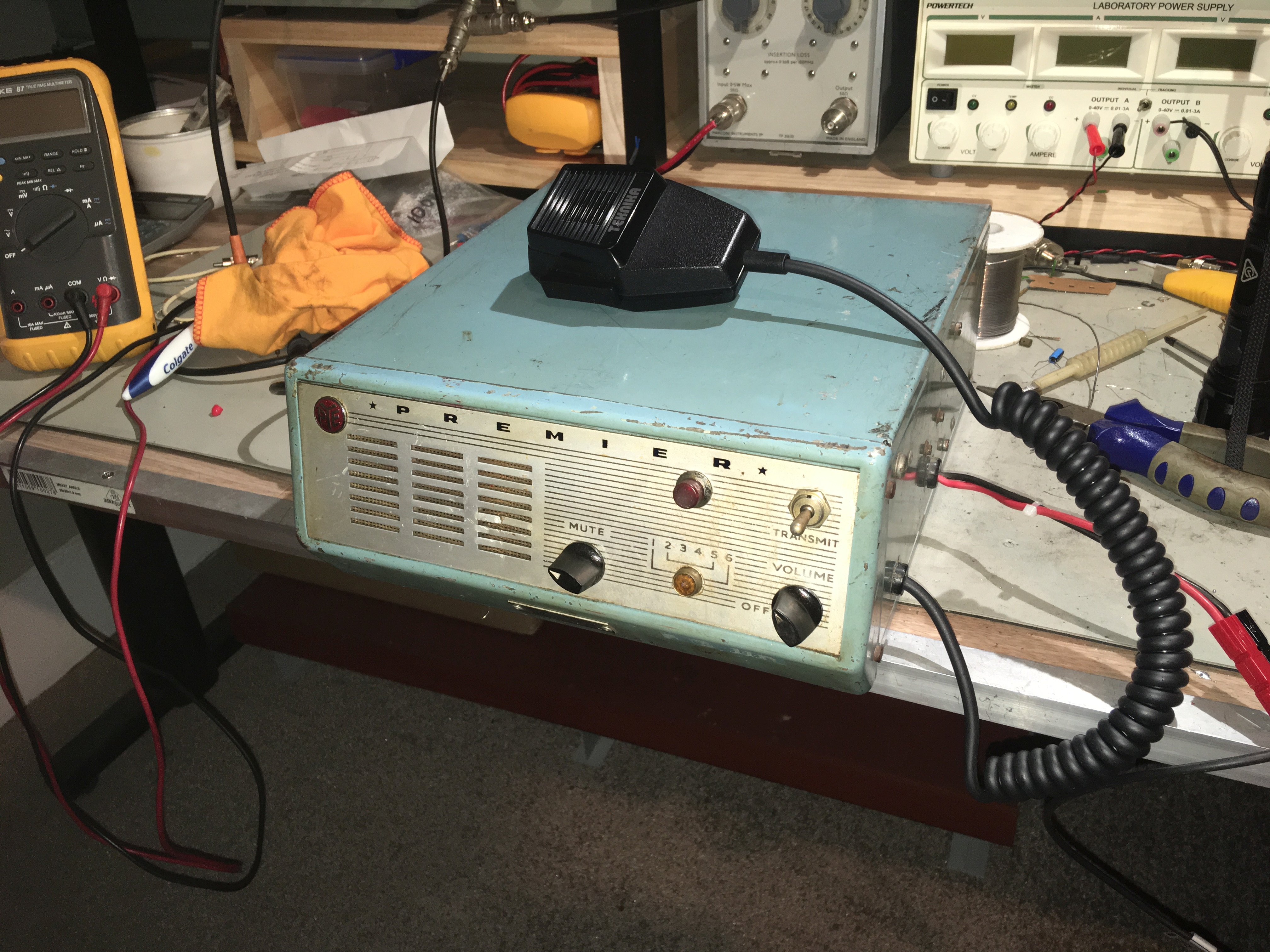
For the uninitiated, 52.525 MHz is the international simplex calling frequency on six metres FM. Over the years I have built at least one 'homebrew' radio and modified a number of ex-commercial radios for myself and other hams. It's a time consuming process but I enjoyed the challenge. Below are some radios from the 1960's, 70's and 80's that were in common commercial use in Australia and often converted to six FM. Further down the page will be my latest homebrew efforts.
The first is an almost all-valve AWA model MR-6A. It would be 'all valve' except that it has some solid state rectifier diodes and two germanium PNP transistors in the DC to DC high tension supply. I have owned this radio since 1978 or there abouts. It produces around 10-12 Watts of RF on transmit and around 0.5 uV sensitivity on receive. I added a MOSFET RF preamplifier to the receiver a couple of years ago. Its biggest drawback is its wide bandwidth 2 MHz IF filter. These radios were used in the day when channel spacing was 50KHz or greater in Australia. I had my first inter-state contact on this band using the AWA MR6 pictured below not long after it was modified for 52MHz in 1978. It was a great thrill talking so far on VHF!
To make this radio more compatible with current band plans and electrical noise from power lines, I have a plan to modify the current I.F. bandwidth of 30KHz to 10KHz. My thinking is to up convert from the current 2MHz I.F. frequency to 10.7MHz then pass the IF signal through a narrow filter then down convert back to the original I.F. of 2MHz. The original 2MHz filter will be removed from the circuit.
The first is an almost all-valve AWA model MR-6A. It would be 'all valve' except that it has some solid state rectifier diodes and two germanium PNP transistors in the DC to DC high tension supply. I have owned this radio since 1978 or there abouts. It produces around 10-12 Watts of RF on transmit and around 0.5 uV sensitivity on receive. I added a MOSFET RF preamplifier to the receiver a couple of years ago. Its biggest drawback is its wide bandwidth 2 MHz IF filter. These radios were used in the day when channel spacing was 50KHz or greater in Australia. I had my first inter-state contact on this band using the AWA MR6 pictured below not long after it was modified for 52MHz in 1978. It was a great thrill talking so far on VHF!
To make this radio more compatible with current band plans and electrical noise from power lines, I have a plan to modify the current I.F. bandwidth of 30KHz to 10KHz. My thinking is to up convert from the current 2MHz I.F. frequency to 10.7MHz then pass the IF signal through a narrow filter then down convert back to the original I.F. of 2MHz. The original 2MHz filter will be removed from the circuit.
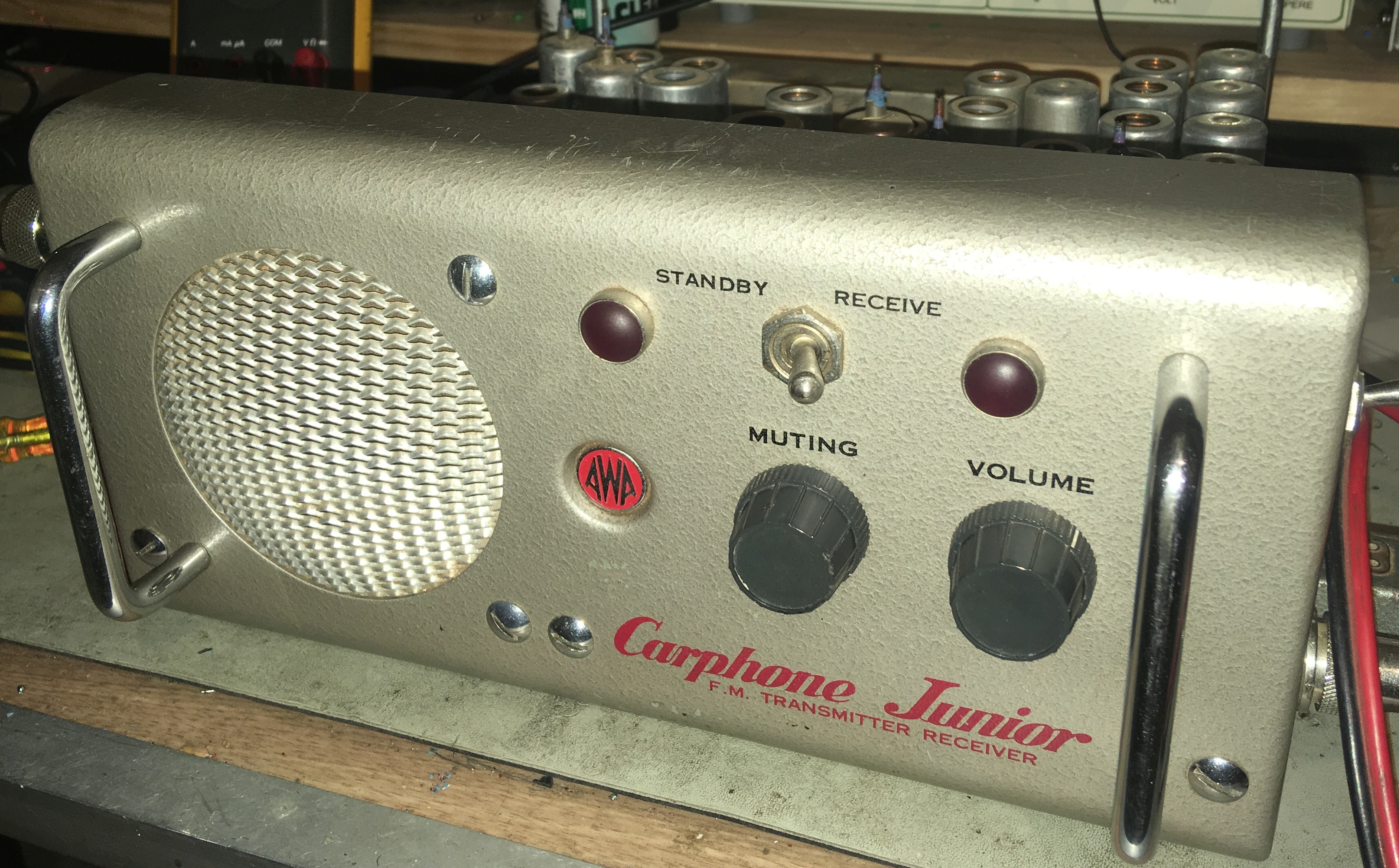
52.525 MHz FM Radios
Last updated on the 24th December 2022
Below are some radios I have converted for use on the six metre FM Band
























The radio below is a Pye MV-516. Originally designed for the Australian VHF mid-band on 70-85 MHz. It had already been converted to the six metre FM band on 52.525MHz by the time I acquired it. I just had to get it going again by fixing a fault in the PA and driver stages. It produces 25 Watts of RF on transmit and a previous owner had built a dual gate MOSFET RF preamplifier to improve its receiver performance.